

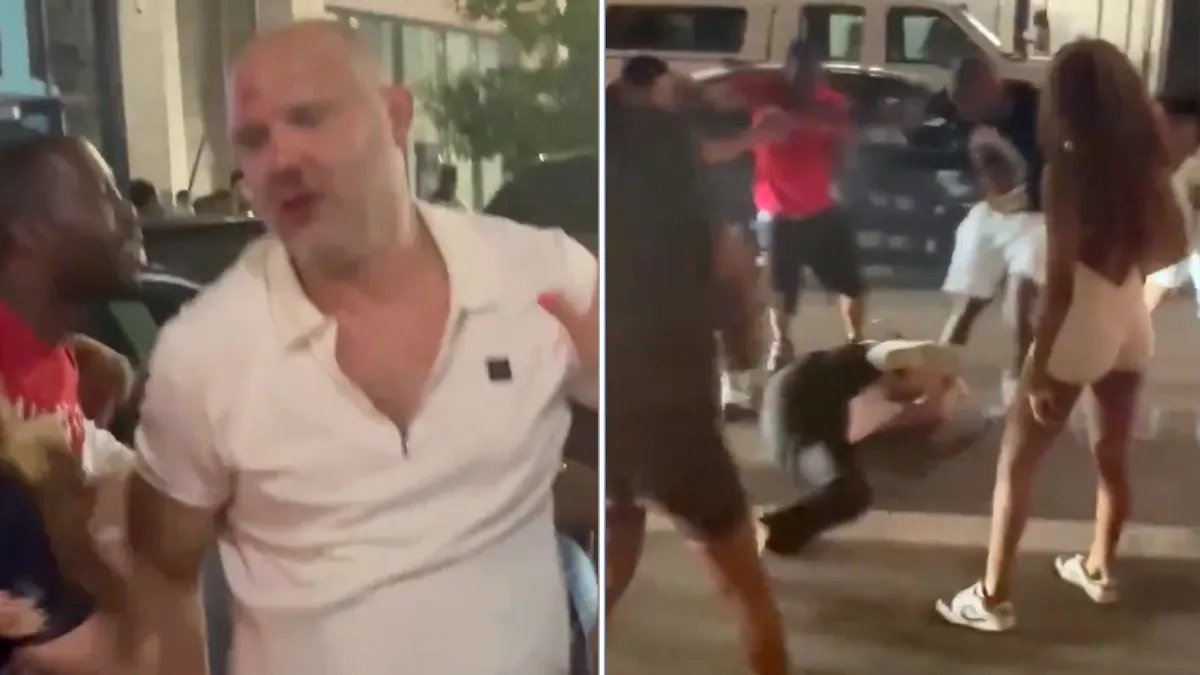
A violent brawl in downtown Cincinnati recently went viral, sparking a firestorm of commentary, criticism, and media spin. At the center of the melee was a white man who ended up badly beaten. But while some media outlets rushed to paint a picture of unprovoked violence committed by Black men, videos of the incident tell a different story: the white man was the aggressor. He instigated the confrontation, became physically confrontational, and bore the consequences of his actions.
Yet, the headlines and public perception are being twisted. Instead of presenting the facts, some platforms are weaponizing the footage to drive a race-based narrative that paints Black men as violent attackers, ignoring the clear role of the white individual in initiating the altercation. It’s a troubling pattern — one that reflects not only bias in coverage but also the unresolved racial tension woven into Cincinnati’s recent history.
The Truth Behind the Fight
Footage of the incident shows the white man yelling threats, invading personal space, and throwing the first punch. What followed was chaotic and violent, yes — but it was a response to his aggression. That fact has been minimized, if not completely ignored, by some media reports that began circulating almost immediately after the incident. They focused on the optics — a white man beaten by Black men — and neglected the facts.
Public reaction has been deeply polarized, with many quick to blame Black youth for being out of control or dangerous. But context matters. When someone provokes a fight, they cannot then play the victim once the situation turns against them. Yet, in this country, racial dynamics often dictate who gets the benefit of the doubt. And in this case, the Black men involved are not being viewed as people who defended themselves or responded to provocation — they’re being framed as criminals.
A History of Racial Tensions in Cincinnati
To fully understand why this incident has ignited such passion, we have to look at Cincinnati’s past. The city has a long and painful history of racial injustice, particularly in its downtown and Over-the-Rhine neighborhoods. In 2001, the city erupted in days of unrest after 19-year-old Timothy Thomas, an unarmed Black man, was shot and killed by police in a dark alley. That shooting, and the dozens before it, exposed deep fractures between the Black community and law enforcement — fractures that have never fully healed.
Gentrification has only added fuel to the fire. In recent years, downtown Cincinnati has transformed from a majority-Black, working-class area into a playground for wealthier (and often whiter) newcomers. This demographic shift has increased tensions, especially as long-time residents feel pushed out, surveilled, and unwelcome in their own neighborhoods.
Even in the workplace, housing, and policing, racism persists. Black Cincinnatians are more likely to be pulled over, arrested, denied loans, or priced out of homes. Unemployment among Black residents remains higher than among white residents. These statistics aren’t just numbers — they tell a story of systemic exclusion and inequality. And in that context, incidents like this brawl become flashpoints that reflect deeper issues.
Double Standards and Media Bias
Let’s ask the uncomfortable question: What if the racial roles were reversed? Suppose a Black man had acted aggressively, thrown the first punch, and was then beaten by a group of white men. Would the public and the press rush to portray him as the victim? Would there be nationwide coverage, or would the story barely make the news? The answer is telling.
Time and again, we’ve seen Black victims minimized or demonized. Their pasts are scrutinized, their humanity questioned, their pain dismissed. But when a white individual ends up on the losing end of a confrontation they started, the narrative shifts to sympathy. This inconsistency reveals the quiet racism embedded in much of our discourse — the idea that violence is justifiable or expected when the victim is Black, but scandalous and unacceptable when it happens to someone white.
Ongoing Investigations and Arrests
As of now, at least five arrests have been made in connection with the brawl, and more may be pending. Authorities are reviewing surveillance footage and social media clips to determine the full scope of what happened. But what’s already clear is this: the man who was most seriously injured was not an innocent bystander. He was the spark that lit the flame.
And yet, it’s not him who faces scrutiny. It’s the Black men who reacted, defended themselves, or got caught up in the chaos — they’re the ones now being villainized. The justice system, like the media, often lacks nuance. Context is cast aside for soundbites and mugshots.
Conclusion
This Cincinnati brawl is about more than fists. It’s about truth, narrative control, and the racial double standards that continue to shape how we see each other. The facts show that the man who was beaten was the one who escalated the situation. Yet the media’s instinct to frame Black men as aggressors speaks to deeper issues in how America still processes race and violence.
Until we can face those truths — and tell the full story, not just the version that fits a bias — moments like these will keep sparking outrage, division, and injustice.
Thanks for letting us know the truth.
I think the response was out of proportion to the antagonism. If the white man “started” things, then certainly the other person(s)had a right to defend themselves but not to the apparent extent of trying to seriously injure or perhaps kill the guy. Somehow we must learn to love each other.
How do you love HATE.
Why are AA expected to always forgive?